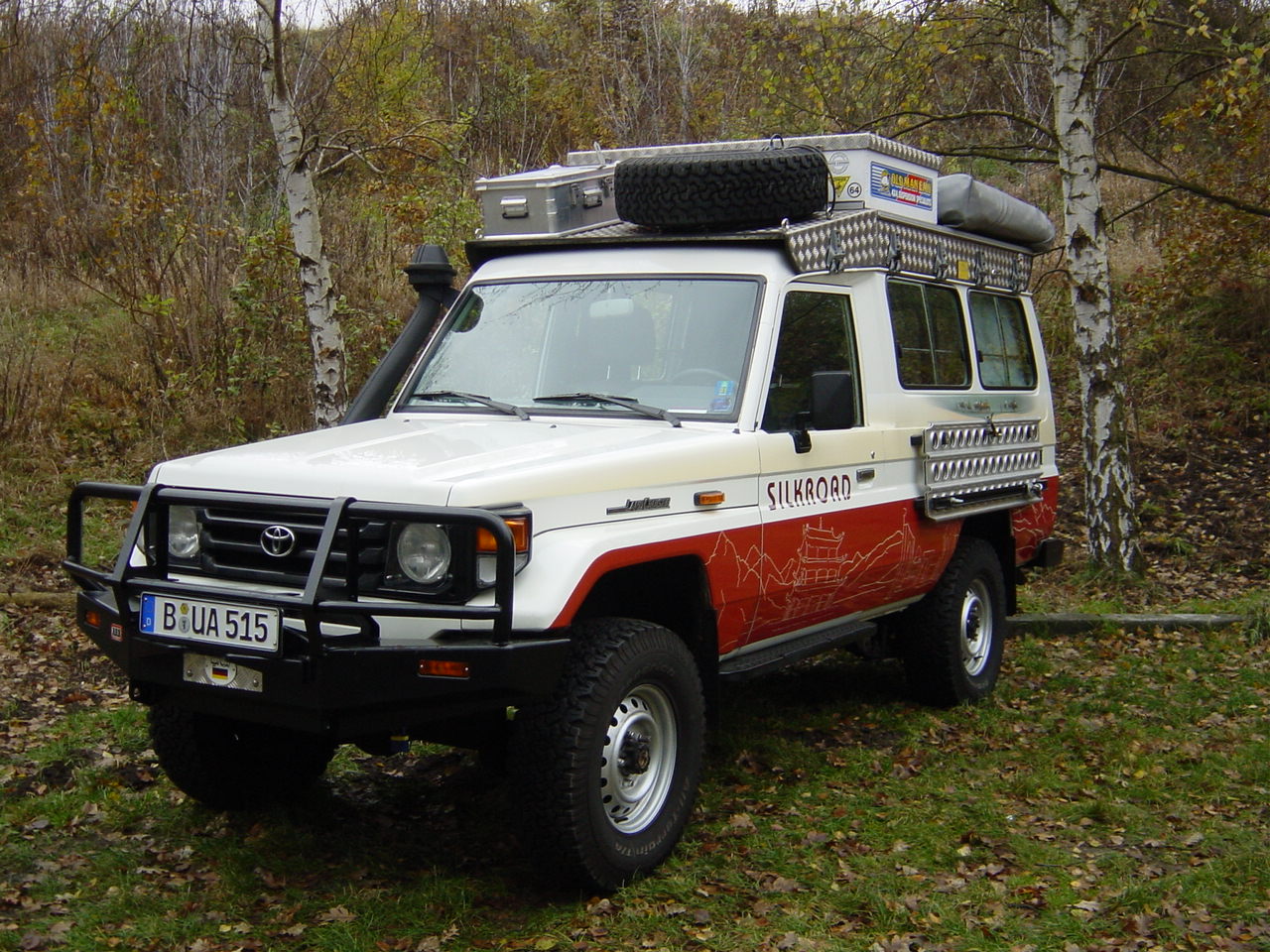
This cruiser has the advantage that you can repair it without a computer and an error diagnosis system due to its simple construction. Although the standard car type almost met our requirements, we still had to modify a few things.
The bumpers already proofed a weak point during our test tour in the Sahara. We replaced the original ones with Australian-made bumpers. The roof rack system fulfills two functions: Due to the layer of air between the cruiser's roof and the rack it serves as an isolator and allows at the same time an easy installation of the rooftop tent and a fastening of our boxes. The chassis was reinforced and a double passenger seat built in. Thanks to the reserve tank we now have a Diesel supply of 210 liters.
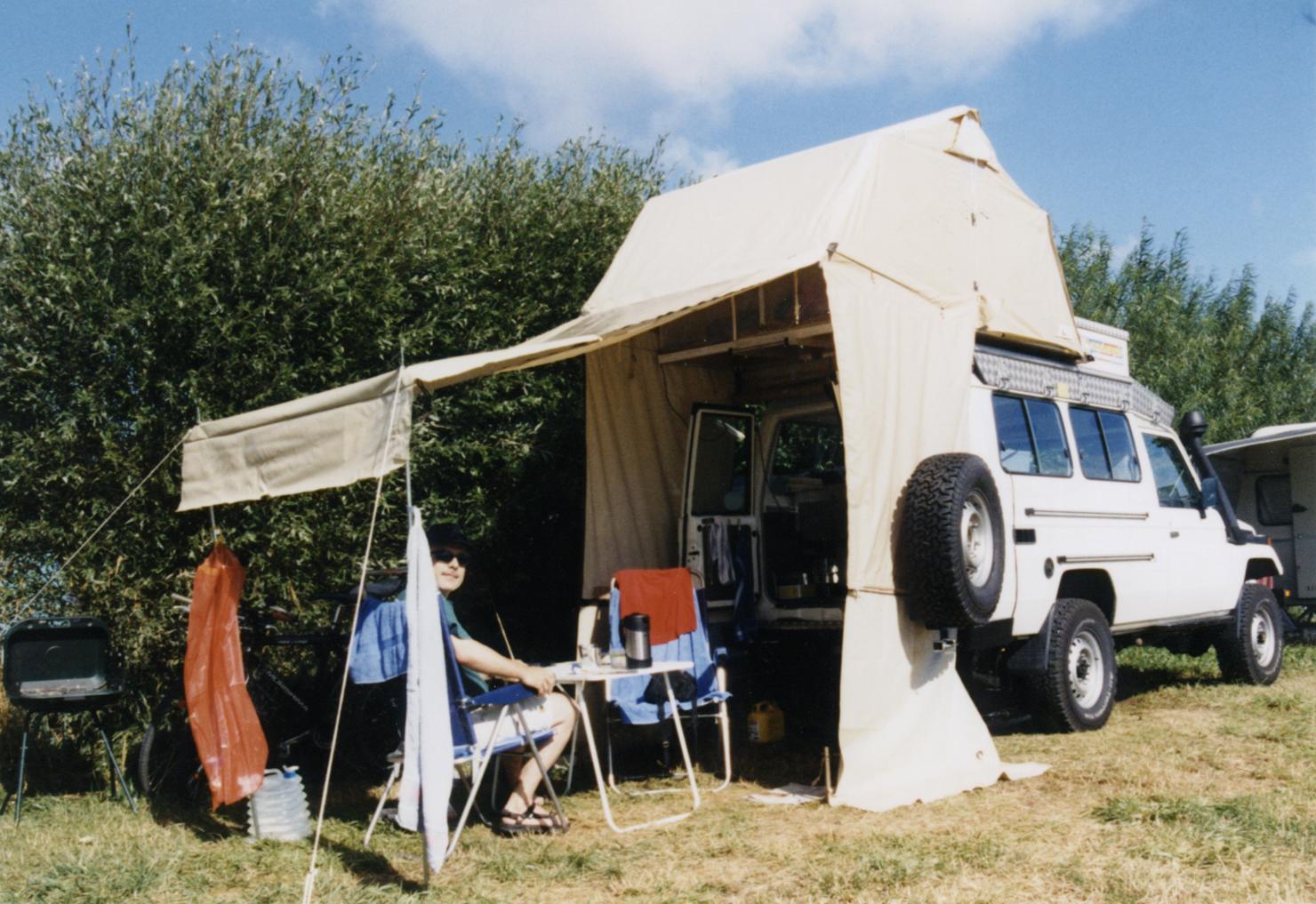
Normally we sleep in the rooftop tent, sometimes in the car on top of our storage boxes. When it is extremely cold, we turn on our stationary heating.
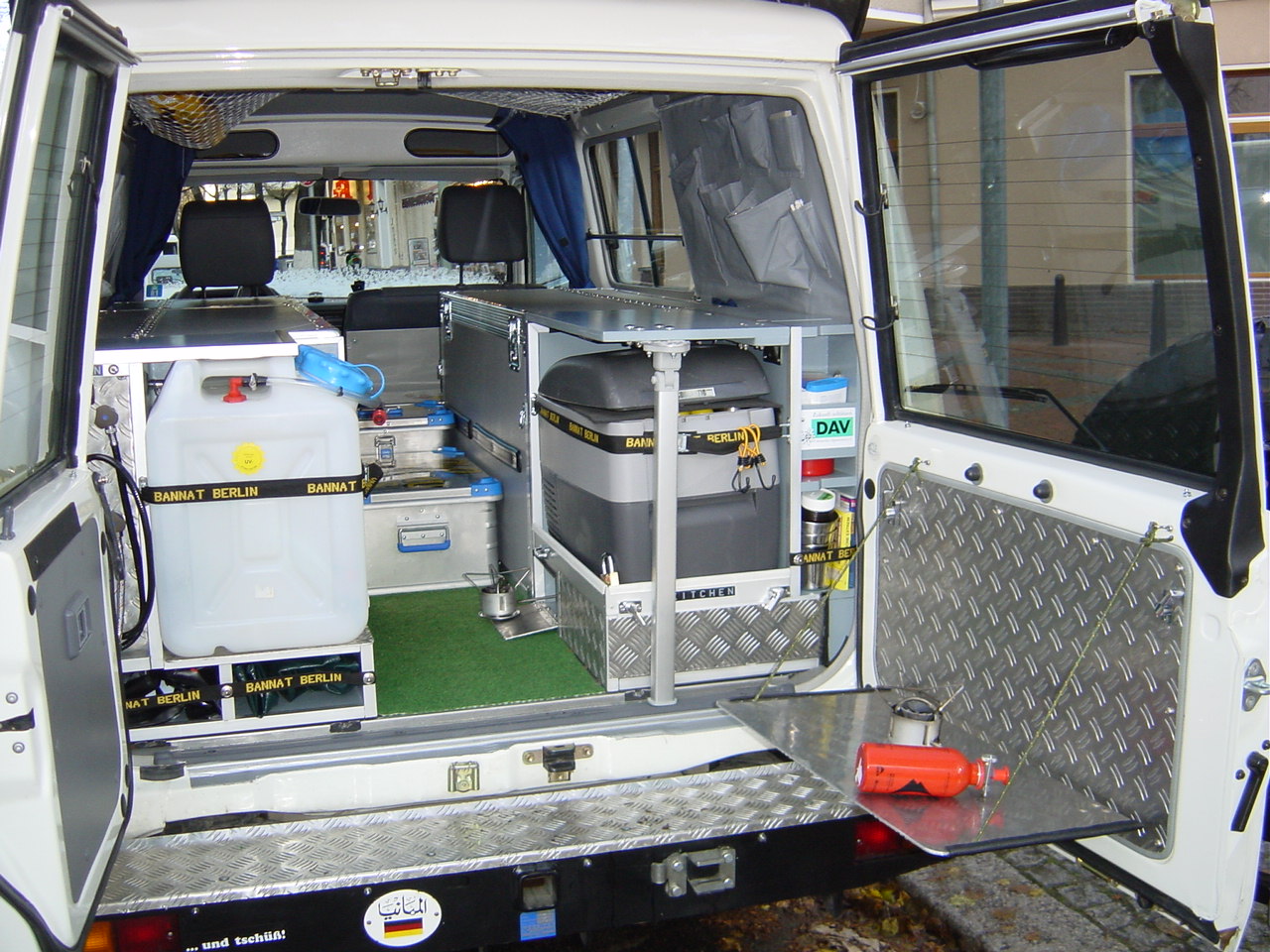
The built-in equipment had to be as robust and impenetrable to dust as possible. Our storage boxes were practically built the same way as transportation boxes for stages to meet our special needs. The water treatment system for a water supply of 44 liters (can hold up to 100 liters) is located on the left and the kitchenette with the compressor freezer on the right. To avoid being out of electricity one day, we installed a solar system. We cook on camping stoves placed on our aluminum folding table.
The worst thing that happened on our trip is and remains what we had to go through with the French shipping company CMA CGM. For two weeks our container was untraceable because it was mistakenly shipped to and unloaded in the United Arab Emirates. If you read the small print of delivery contracts you will see that shipping companies are not liable for anything, not even for the financial losses we incurred due to the fact that we had to stay in Bombay longer than planned which was pretty expensive. Arrogance, the wrong information or no information at all - this greatly disappointed us!
The second worst disaster we experienced was when our visa card was stolen. Despite a permanent mailing address in Katmandu, the bank was not able to send us a new card within four weeks. We decided we no longer needed the "freedom" of possessing a visa card. Advertising and reality seem to diverge widely!
Unfortunately, the brand new satellite phone from Thuraya only worked until we arrived in China. The import firm gave us the tip to buy two phones at the same time - just in case!
Regarding our MSR stoves: The pumps turned out to be their weak points. We definitely advise you to take enough spare parts with you (especially nozzles).
Having a German shoe size of 45 is a big problem! Pack extra shoes because in Asia you cannot buy any shoes larger than size 43.
Considering the difficult conditions, our rooftop tent from Autocamp proved to be quite okay - at least after the many improvements we personally made to it. We are bothered by the wear on the tent fabric made by the aluminum parts. The manufacturer will get from us at least ten suggestions for improvement.
The liquid in the expensive Suunto car compass just evaporated. It's now absolutely useless!
It took a short time for the new Webasto stationary heater to no longer work.
All in all, our Toyota land cruiser has turned out to be a reliable vehicle considering the fact that it was pushed to technical extremes. The land cruiser was only one year old when we left Berlin, so that we were surprised to encounter the following problems: The brand new OME chassis didn't stand the test at all. One spring broke in Tibet due to faulty material and we wore out a total of five bumpers and one steering absorber. After serial Toyota shock absorbers were installed in Tibet, we no longer had any problems. Considering the OME chassis: we assume it has a faulty design because the length of the absorbers and that of the springs don't match. We are still waiting for a gesture of goodwill from the Taubenreuther company. They asserted that we overloaded our vehicle. So we put our vehicle on a weigh scale to prove the contrary. With success! The aluminum roof rack from Innovationcamper broke in at least five places and is unsuitable for such a trip. Maybe it is different driving through the soft Sahara sand with an insignificant load. We would not choose BF Goodrich AT tires for another of these tours. All seven of our tires only lasted until we reached Kashgar, India. Two tires had almost no tread when we arrived in Tibet after a tour of only 5,000 kilometers. We are very pleased with the quality of the Chinese tires we got in Kashgar, which enabled us to also drive through difficult terrain. Reinhard Mazur from Austria did a similar trip: His car had Michelin tires and (surprise!) he came home with tires still having a tread of 8 millimeters deep.
In addition to the above, we had the following problems with our vehicle: Both car batteries boiled over which led to enormous corrosion damage in the engine compartment due to the acid. Our suggestion is to use fully enclosed or gel batteries. The diesel pump had to be completely overhauled in Nepal. We recommend always taking an original Toyota overhaul kit along while traveling. Not to forget: In Nepal the valves had to be completely readjusted because they were absolutely beyond the permissible variation. A new seal for the injection nozzles had to be custom made in Lhasa on a lathe. The body frame of the windshield is cracked on both sides. Stones also damaged the windshield during the trip. The air conditioning often did not work which made it very unpleasant at temperatures of more than 40 degrees Celsius. The rubber collars of the steering rods were also worn halfway through the trip. It's best you take along some extra as spares with you on a similar trip as they don't take up much space. We also recommend taking some paint and a brush to immediately paint over damage caused by stones so that rust doesn't have the chance to take hold. Heavy vibration caused the rubber hood seals to polish the metal to a shine.
OME-undercarriage after 3,000 kilometers of Tibet (MPEG, 270 KB)